Posts

Life and Death in the Landscape

Image
 The reality of creating a living landscape is that some of the life that is created dies. That's the way nature works. A few evenings ago, I watched a great egret hunt anoles along the fence that separates my backyard from that of my neighbor to the east of me. I'm told that this hunting behavior is relatively new, but it should have been easily predicted. Brown anoles are virtually everywhere in my yard and the landscapes of all my Florida neighbors and they constitute a food resource that has been underutilized. Nature detests that. One niche opens up and a species comes in to fill it.  Egrets have been hunting and eating reptiles and amphibians along wetland edges for generations. It was only a matter of time before they learned to exploit this overabundant food source in the uplands nearby. We often assume that we know how nature works, but our knowledge base is founded on such a very short time geologically; our "normal" is founded on a very limited database. Na...

Plant Blindness

Image
Over the past years, a lot has been written about plant blindness -  described as the "inability to see or notice the plants in one’s own environment”.  This tendency is so widespread that Elisabeth Schussler and James Wandersee, a pair of US botanists and biology educators, coined the term in 1998. Since that time, a huge body of work has been devoted to it and the results of all the studies clearly show that it is an issue we should be paying attention to. For most of us, our mental images of animals are sharper than those of plants. Children recognize  that animals are living creatures before they can tell that plants are also alive. Tests of recall also show that study participants remember pictures of animals better than images of plants. For instance, one US study  tested “attentional blink” – the ability to notice one of two rapid-fire images – using pictures of plants, animals and unrelated objects. This showed that participants more accurately detected image...

Location is Everything

Image
Newly Planted Mountain Laurel New Planted Saffron Plum Today, I finally planted what may well be the last two woody plants I will add to my landscape. It has taken me weeks to do this as I wanted to make sure that I had chosen places for them where they could thrive. Unlike animals, plants cannot move to a better location once they are anchored in the ground.  They are amazingly resilient beings, but they have to make do with the conditions we give them. We play God when we plant them and it is best when we are a wise one. I have spent over a year searching for both of these two plants. They are not commonly propagated by the commercial native plant nurseries here. Perhaps because the demand is not great for one and because basic large-scale propagation techniques do not work well for the other. The saffron plum ( Sideroxylon celastrina ) is a narrow-crowned evergreen shrub/tree that has a heavenly fragrance that attracts the attention of all kinds of pollinators and produces small...

Life is Tenuous, Even if We Prepare For It

Image
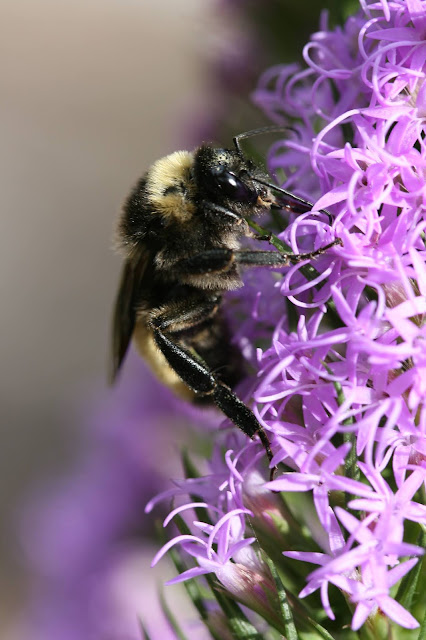
Over the past few days, "my" bumblebee has been visiting each morning - nectaring mostly on the flowers in a large patch of red salvia ( Salvia coccinea ) I have left alone to expand in the far southeast corner of my yard. Yesterday, it brought a friend and I was ecstatic that he/she thought to do so. Perhaps I've finally become a bumblebee stopping place. This patch of wildflowers is next to a firebush ( Hamelia patens ) that is growing by leaps and bounds and a recently planted coral honeysuckle ( Lonicera sempervirens ) that will all serve to entice hummingbirds to dawdle for as while. I've had a female several times here in the last few days. She doesn't stay long, but she wouldn't be here at all without these plants. My front yard pollinator garden is also attracting the attention of a great many bees and butterflies right now. It is a great time in Holiday for living landscapes. The problem is that I know life to be tenuous.  Last year, every invertebrat...

Defined By Our Roots

Image
There are no more-powerful organs than roots. They define everything about a plant and, though largely unseen, everything that we see above-ground is determined by them. It is no wonder then that we talk about our own roots. They do the same. As I watch the birds that now visit my feeders, I think I relish most the visits by the Carolina chickadees and Carolina wrens. Although the differ a bit from the birds of my Wisconsin youth, they bring back memories of the birds I grew up with and I am then struck by how my roots define me. Just as the roots of plants anchor it and supply the nutrients necessary for its life, ours do the same for us. We never actually escape our own roots no matter how many times we move about the world. Where we were first planted nourishes us for the rest of our lives. As a Midwestern child of the 50's and 60's, I wandered the hills of southern Wisconsin, exploring the magic of spring in the deciduous forests that were near me. Perhaps that is why I am ...

Timing Is Everything

Image
Bumblebee nectaring on native Garberia heterophylla Hummingbird clearwing moth nectaring on a nonnative Buddleia As I've written before, my Holy Grail of pollinators in my new landscape is the continual presence of bumblebees. For the past week, I've had one in my yard and it shows up each early morning to visit my patch of native red salvia ( Salvia coccinea ). It is not the plant I would have guessed that would entice the visits, but I am excited to see it. I don't see the bumblebees later in the day yet, but they visit me routinely in the morning hours - and only on this plant although I have dozens of blooming wildflowers for it to choose from. I've learned over the years that timing is everything - much more important than the exact species of flowering plant. Plants are not identical in what they provide and they do it much more "intelligently" than most folks seem to understand. As I have more time right now to watch the pollination of my flow...

The Quest For Bumblebees

Image
To me, the holy grail of pollinators is the bumblebee. It is my ultimate quest here in my new landscape to have them as regular visitors and to have them create a nest and produce more. Since I first began my landscape makeover here I have witnessed an exponential curve in the number and types of pollinators that now share my new home with me, but I have seen very few bumblebees. They are the most elusive visitor that I have and the one I would completely miss if I was not specifically looking out for them. Yesterday, I saw one making the rounds of my backyard wildflowers and I saw one several days earlier. Perhaps, my grail is close at hand. My love of bumblebees has not been a constant over my life. It began in childhood - perhaps at the age of 7 or 8, when I discovered that there was a bumblebee nest in the tattered cushion of our toboggan in the garage. I watched, partly fascinated and partly scared, as bumblebees entered and exited the cushion, flew out the open garage door, an...