Posts

Playing Nice is Important

Image
  It's been a while since I've posted anything about our landscape here in Pasco County.  With the long extended drought early this summer and my new job as Director of the USF Botanical Garden, this landscape has been largely negleacted - left to its own defenses.  We don't have irrigation anywhere except for a couple of hoses; true here in the wildflower meadow as elsewhere. If you could read the rain gauge in the center of this photo, it would have not registered a single drop of rain for a nearly 2.5-month period from May-early July.  What little rain fell during this time in Tampa where I work, did not reach this landscape. Now that Idalia has left and a few other rain events have reached us, what is left are the survivors and it looks a little bleak.  We've lost a few things, but mostly everything that popped back out of the ground in early spring is still here and that's a relief.  I hate losing plants and it demonstrates the need to plant the right ...

The Importance of "Catastrophes"

Image
  Hurricane Idalia just passed us this morning and left our landscape intact.  Not the same for areas near Cedar Key and the Big Bend area of Florida which were hammered by 100+ mph winds and devastating high tides.  Large swaths of Florida were recently submerged in saltwater and likely will remain so for at least several days.  As most plants are not at all adapted to saltwater inundation, a great many landscape plants and vegetation in natural areas will perish.   News reports often refer to such events as catastrophic ones, yet it is these very events that determine the ecology of an area. Wildfires, severe freezes, avalanches, and hurricanes are vital to the nature of plant communities everywhere.  They may be uncommon, but that doesn't diminish their importance.  They are so-called "keystone" events.  What we take as "normal" plant communities are their result. Florida is a unique example - at least for North America.  We are shape...

You Need To Know Your Plants

Image
Cordia sebestina   A few days ago, I saw a wonderful photo of a sulfur butterfly nectaring on the flowers of a geiger tree on a social media site that I am a member of.  The ensuing comments were expected.  Everyone wanted this plant....... but did they really?  I also saw a post from a different member asking for input on her butterfly garden plan; one that she obviously had paid someone to design.  These two separate posts have at least one thing in common - the folks wanting to have landscapes beneficial to wildlife did not take enough time to learn plants they were wanting to add. I can write this. In my first days of embracing the native plant movement, I quickly thought that I knew what I was talking about and the reality was that I knew almost nothing.  What I knew came largely from listening to others and from browsing through a few books.  I had almost no firsthand experience.  In a way, I was saved by the fact that there was no such thin...

It's Much More Than Nectar

Image
Skippers on Camphorweed ( Pluchea spp.) Photo by Trudy Kenderdine & used by permission I love working with kids and since I've assumed the role of Director at the University of South Florida Botanical Gardens I often have the opportunity to take kids of all ages on guided walks.  One of first stops is always at the "Butterfly Garden".  I call it that, because it came with that sign when I first started there last year,  so it must be so... In truth, it was a terrible butterfly garden until we started to fix it - and that leads me back to the kids and guided walks. I enjoy asking questions that require critical thinking; often questions that I don't expect anyone to correctly answer.  It's golden when someone does, but that's never the point.  I ask questions that I hope will stimulate thinking.  In this case, and most others, that means questions meant to stimulate thinking about the natural world and why things are the way they are.  At the entran...

Water & Watering

Image
 As I write this, Jane and I have had only one measurable rain event in the past 4 months - 3/4's of an inch about a week ago.  It is no exaggeration to say that our landscape is parched.  Some that I know in the native plant movement decry the use of potable water to assuage their landscape plants; saying things like "if my plants can't make it on their own, they are not appropriate to my landscape."  The idea being that a "native plant" should be able to surive on its own without additional inputs such as water.  While I understand this line of thinking, I would argue otherwise.  It comes down to the question of why we're planting natives in our landscape at all. If our ultimate goal is to create a landscape that survives completely on its own without any assistance, watering during times of extreme and unusual drought makes sense.  It's just not why I plant natives.  My goal here is to create as much plant diversity as possible on my 1/4-acre s...

Things You Should Know

Image
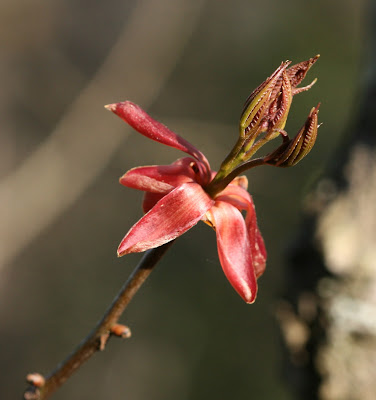
                                                                                            Red maple In actuality, there’s a great many things that you should know and this is really not the most important one.  It’s just that this simple thing is something that I’ve had to answer a great many times lately from posts on social media and from questions I get when engaged in public speaking.  It has to do with knowing where the plant you have added or plan to add to your landscape originally came from.  I think that most of us purchase a plant never knowing this.   We either trust that the advice we get from friends or a nursery suffices; that they wouldn’t be selling this to you if it wasn’t app...

Cold Is A Welcome Visitor

Image
  This seems to be a colder winter here than most.  Nearly a month ago now, our temperatures dipped slightly below freezing for 2 consecutive nights and periously close to that on another.  The surface water on my bird bath froze and I had to bring in my collection of non-native orchids.  Across the world of social media, folks here in Florida bemoaned the destructive force of a hard freeze (or even a frost) on the plants in their landscape.  Perhaps, I am just simply eccentric, but I welcome this kind of weather to my landscape.  Cold is one of the most important abiotic forces to a Florida landscape.  It resets the table and cleans up the clutter. Florida is different from other places where I've lived.  Our weather patterns are certainly not uniform and that greatly impacts the types and species of plants that naturally occur here.  As a big, somewhat open-toed sock, plants naturally stream southward down from the states along our open bor...